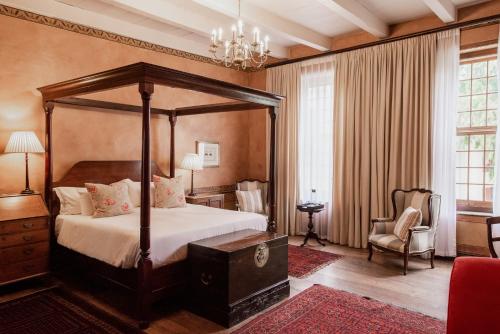
Construído na década de 1780 e juntamente com os seus edifícios vizinhos que outrora albergaram armeiros, padeiros, fabricantes de carruagens, etc., este hotel faz parte da Heritage Square, uma praça centrada em torno de um pátio íntimo onde os visitantes podem desfrutar do seu café à sombra da mais antiga videira frutífera da África do Sul. O hotel, embora totalmente renovado, oferece passeios pelas instalações e pela praça para que os hóspedes possam apreciar os acabamentos e murais originais expostos nas paredes.
Ano de construção:1771
Qual é a historia do imóvel?The Cape Heritage hotel is an integral part of the restored Heritage Square, which dates back to the 18th Century. Our central courtyard is shaded by South Africa’s oldest known fruit-bearing grapevine, a calm oasis from which to explore the Mother City.
Qual foi a época e/ou o estilo arquitetônico em que o imóvel foi construído?The Cape Heritage Hotel is an integral part of the restored Heritage Square, which is bordered by Buitengracht, Hout, Bree and Shortmarket streets. The earliest Dutch and Georgian houses were built in 1771. The Cape Heritage Hotel itself was built in the 1780′s.
O imóvel está rodeado por outros edifícios históricos?Archival research shows that most of the original buildings were used for commercial reasons. Tobacconists, snuff makers, gunsmiths, bakers, coach makers and wheelwrights prospered here. There was a rope warehouse, several retail outfits, a boarding house, a chapel and an undertaker.
Foram efectuados trabalhos de restauração?The vine – and Heritage Square itself – might not be in existence if the city council had had its way. In the 1960′s, Heritage Square was earmarked for demolition.
In its place, there were plans to establish a multi-storey car park. Luckily, finances to complete this project were never forthcoming. Instead, at the end of the 1980s, consent was granted to renovate the square, starting the largest private conservation project the city has ever known. For more information on the restoration of the square, visit the Cape Town Heritage Trust’s website.
Existem elementos de particular importância histórica no edifício?Many historic features are still clearly visible in the hotel. Exposed original wall finishes and murals are complemented by dëcor that reflects Cape Towns diverse historical and cultural heritage.
Há algum hóspede importante ou proprietário anterior que valha a pena mencionar?J.B. Munnik, the first person in South Africa, and the 4th in the world to be born by caesarean operation.
Há algum acontecimento importante que tenha ocorrido no imóvel no passado?In the early days of Cape Town’s existence, the roads and streets around Heritage Square were some of the most important thoroughfares of the early colony. Buitengracht Street, for instance, which marked the western border of the property, ran along the canal marking the outermost limits of the original Dutch settlement, established in 1652. Shortmarket Street, on the Southern side, leads directly to Greenmarket Square, the original market place for fresh farm produce.
Riebeeck Square, named after the pioneering father of permanent European settlement, was first known as Boere Plein after the free Burghers, who brought their ox wagons here to sell their farming produce. Later still, it was known as Hottentots’ Plein after the noisy, Khoi farmhands who manned the farmers’ wagons.
In general terms, the houses of Heritage Square were built in typical 18th Century Cape Town architectural style, the earliest of which was documented in 1771. Archival research shows that these were not entirely residential building and all the owners engaged in some form of enterprise, ranging from blacksmith to retail and tobacco manufacturers. Businesses included tobacco and snuff makers, gunsmiths, a bakery, a wheelwright, a warehouse, coach makers, several retail outfits, boarding houses, a chapel and even briefly, an undertaker.
At 108 Shortmarket Street, the building was designed with the usual conspicuous front entrance (the building’s public face) –Whilst the rear of structure was accessed through a narrow alleyway, which led to the rear courtyard, out rooms and kitchen. This hidden dimension of the building would have been used by servants, slaves or people residing in the backrooms.
J.B. Munnik, the first person in South Africa, and the 4th in the world to be born by caesarean operation, owned 108 Shortmarket Street. This unique operation was performed by an even more unusual historical figure, Dr. James Barry (who is reputed to have been a women, disguised as a man, in order to practice medicine); and James Barry Munnik was named after him/her.
By the end of the 19th Century the insurance plans indicated that the cluster buildings which today make up Heritage Square were already a mixed commercial area with manufacturing enterprises, with boarding houses and hire houses in the same block. The owners, and the times, may have changed, but Heritage Square is possibly closer to its historic roots now than any other time this century.
A propriedade recebeu alguma certificação pelo seu status histórico?Heritage Building
Descreveria a sua propriedade como (ou alguma vez foi no passado) a:Hotel
Há algum aspeto que gostaria de salientar, acrescentar ou clarificar?Heritage Square
While the hotel dominates the square, this historic area is also home to a variety of restaurants and shops - so you don’t have to wander far to satisfy your needs.
The VineLike many houses of the day, it was centred around an intimate courtyard. A grapevine, planted in this courtyard in 1781, still flourishes today, bearing fruit and shading guests who shelter here for their daily repast. Thanks to vigorous pruning each year, the oldest known fruit-bearing grapevine in South Africa survives without ever being fed or watered!